
Anyway, Reflecting #5
Introduction to three sound sources frequently used in the process of creating electronic and electroacoustic music

Hello fellow readers, after a long delay, this series of articles continues!
This time, I’ll introduce three sound sources frequently used in the creation of electronic and electroacoustic music. This introduction to these three sound sources stems from my personal observations of the many electronic and electroacoustic music works and performances I’ve listened to and watched since 2016.
Synthesis Waveforms
Sound waves (waveforms) are the result of air vibrating, traveling through a medium, and being heard by our ears. The speed of these vibrations affects the intensity of the frequencies we hear, which we then recognize as pitch.
The description above describes the natural process of acoustic sound production, but this phenomenon can also occur in other forms. As in the early days of electronic music, sound waves in the form of analog signals could be created using electronic devices called oscillators. Today, digital versions of oscillators can be used in many digital audio workstations (DAWs) and other audio software (in this case, the sound waves are digital signals). The term for sound waves produced through electronic processes is called synthesized waveforms.
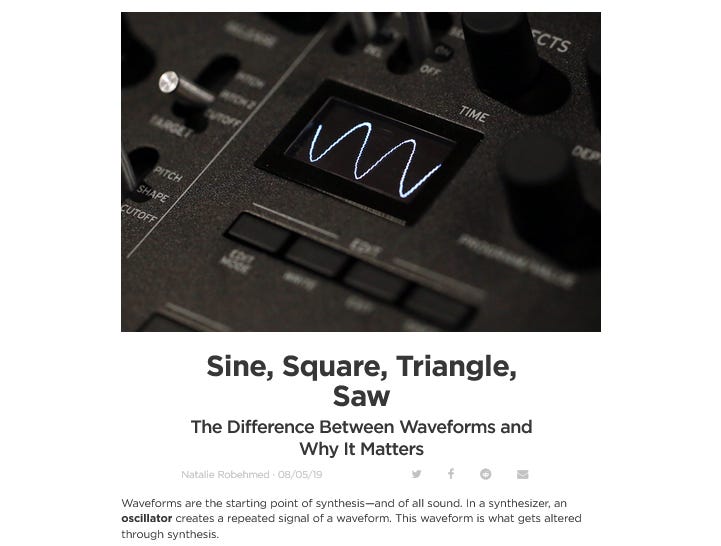
Synthesis waveforms, or synthetic waveforms, basically consist of sine waves, triangle waves, square waves, and sawtooth waves.
These synthetic waves have their own sound characteristics, based on the visual shape of the sound wave (usually visible through a spectrogram).
If you are curious about how each of these synthesized waves sounds, please visit the following article written by Natalie Robehmed, which also provides sound samples of sine waves, triangle waves, sawtooth waves, and square waves (highly recommended to use a headset/earphones):
Perfect Circuit: Sine, Square, Triangle, Saw - The Difference Between Waveforms and Why It Matters
Furthermore, in the case of electronic music, numerous synthetic sound manipulation techniques can be applied to synthesized waves to construct musical material for the music being created. These techniques, of course, produce distinctive and varied effects. Examples of these manipulations include additive synthesis, frequency modulation synthesis, amplitude modulation synthesis, subtractive synthesis, granular synthesis, and many more.
Let’s listen to three works that are entirely made from the process of electronic sound wave synthesis from Éliane Radigue entitled “L’Île resonante” [2000], then John Chowning entitled “Stria“ [1977], and Laurie Spiegel entitled “Patchwork“ [1980] through the YouTube channels “Fran P.“, “Asymmatrix“, and “Laurie Spiegel - Topic”:
Éliane Radigue - “L'Île re-sonante” [2000]
John Chowning - “Stria“ [1977]
Laurie Spiegel - “Patchwork“ [1980]
Audio Samples
Simply put, an audio sample is a sample of a sound recording of a certain duration, generally taken from ambient acoustic sounds. However, over time, these recording sources can even be taken from previously created musical works/songs. These can be soundscape recordings, recordings of single sound objects (kick drums, whistles, etc.), short excerpts from other people’s works/songs, short/long audio files resulting from electronic synthesis, and many more.
Starting from the emergence of concrete music (you can read about it in my previous article in “Anyway, Reflecting #3”), which in the process of making music uses samples of acoustic sound recordings on magnetic sound tapes until the emergence of computers that can implement this process digitally, so that the sound recordings can be in the form of digital files, of course with various formats (.mp3, .wav, .aiff, etc.).
Let’s listen to the album entitled “Floral Shoppe” [2011] by Macintosh Plus, and the work “Hajnal” [2005] by Venetian Snares, then “Xtal” [1992] by Aphex Twin, then finally the work “Türen der Wahrnehmungen (Doors of Perception) Part I” [1989] by Hildegard Westerkamp through the YouTube channels “immortalyear”, “Venetian Snares - Topic”, “Aphex Twin”, and “figure32a”:
Macintosh Plus - ”Floral Shoppe” [2011]
Venetian Snares - “Hajnal“ [2005]
Aphex Twin - “Xtal“ [1992]
Hildegard Westerkamp - “Türen der Wahrnehmungen (Doors of Perception) Part I“ [1989]
Live Signal Processing
Live signal processing is the process of analyzing and modifying signals in real time. In this context, the signal in question is audio. An example of the process sequence is that acoustic sound waves are captured (using a microphone) and converted into electrical (analog) signals. These are then converted into binary code to digital signals so they can be modified. These are then converted back into electrical (analog) signals to be projected through a loudspeaker so they can be heard again as acoustic sound waves. As a side note, the audio source can be any acoustic wave.
The example above represents part of audio signal processing involving digital devices. In other cases, such processing can also be done solely with analog electronic devices (e.g., a vocoder). In certain cases, such as in an electronic device called a variophone, the converted signal is not an acoustic sound wave but rather the dimming of light shone onto a long reel containing a black-and-white image in the form of a wave pattern. This is then captured using a light sensor and converted to produce an audio signal projection.
Of course, over time, the use of this signal conversion process has seen many variations. One example is the direct data sonification process.
From my experience listening to and watching several musical works involving live signal processing, the sound manipulation process is often based on a fixed system, or it’s flexible and can change according to the creator’s wishes. I typically find this in live musical performances.
Let’s listen and watch some works using live signal processing below: Kraftwerk’s “The Robots” [1978], Melody Loveless’s “Count” [2019], Wayne Grim’s “233rd Day” [2017], and Arseny Avraamov’s “Ornamental Sound Animation” [1930s] for the variophone. These videos are from the YouTube channels “Jozin”, “Melody Loveless”, “Exploratorium”, and “StrayPixel”:
Kraftwerk - “The Robots“ [1978]
Melody Loveless - “count“ [2019]
Wayne Grim - “233rd day“ [2017]
Arseny Avraamov - “Ornamental Sound Animation“ [1930an
Closing words?
While there are differences between the three sound sources mentioned above, they are often combined and juxtaposed. This article is simply an attempt to examine in more detail the differences between the sound sources frequently found in electronic and electroacoustic music.
Through this introductory explanation, I could be wrong or right.
If you feel that some things need to be corrected, I would be happy to invite you to write them in the comments column so that we can discuss them together and see the many points of view on this topic.
That’s all from the fifth edition of “Anyway, Reflecting”,
Stay healthy and continue in my next post!
Rangga Purnama Aji, 2024.
(Revised and translated into English in 2026)