
Anyway, Reflecting #4
A Glimpse into the Musicality of an Improvisation Music Performance by Oren Ambarchi


In this fourth edition of “Anyway, Reflecting”, I will briefly discuss my personal reading of Oren Ambarchi’s musicality through an improvisational music performance he performed at the Exploratorium in 2016. This article is an attempt to rewrite and revise a tweet thread I created in 2021:
(Source Link)
Below you can watch a video of approximately 53 minutes (I highly recommend using a headset/headphone/speaker) via the YouTube channel “Exploratorium”, which features a performance by Ambarchi that I will discuss:
A Beginning
Oren Ambarchi is an Australian composer and musician, as well as a multi-instrumentalist who primarily uses guitar and percussion. He was also named “Experimental Artist of the Year” in 2014 by Pitchfork magazine.
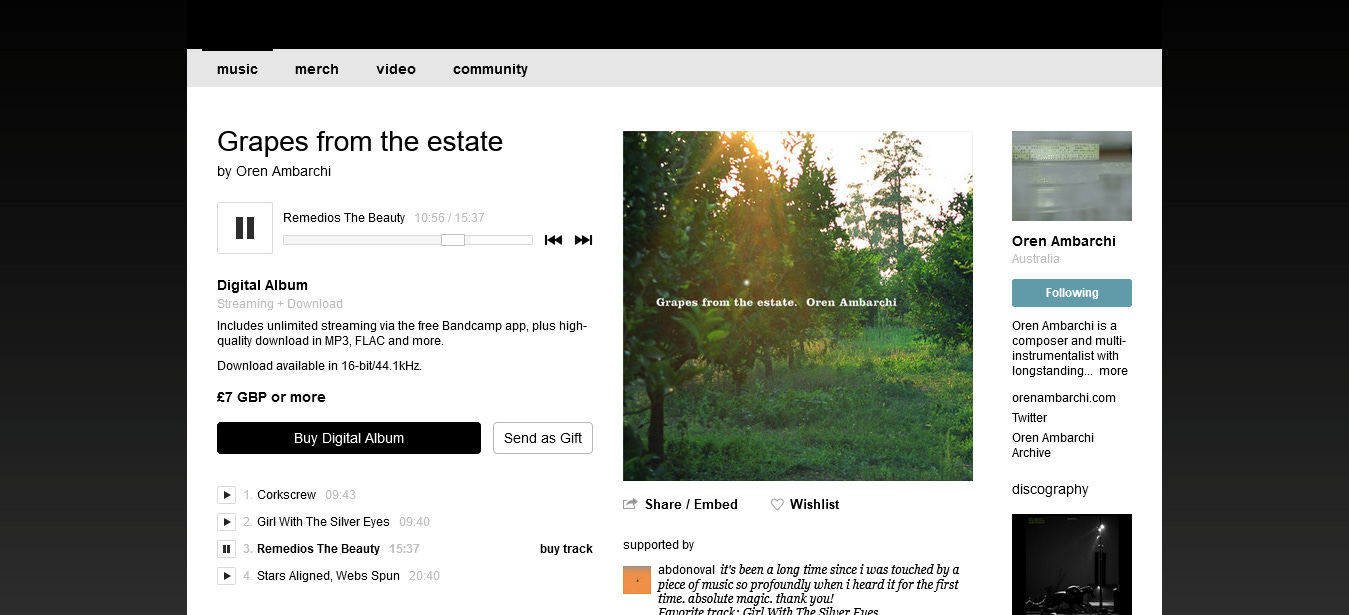
I first learned about Oren Ambarchi in 2021, when I discovered his album “Grapes from the estate” [2004] on a YouTube channel that, at the time of writing, I haven’t been able to find again.
From the album, I found several aspects that I think are unique regarding the processing and musical momentum of his works.
Starting from the buildup of drone sounds with several high-medium-low pitch changes and their extensions, the use of sound transients as an emphasis on a rhythmic pattern, the gradual increase in sound intensity slowly, as well as the contemplative atmosphere from the combination of electroacoustic manipulation processes using several electronic devices on an electric guitar, along with the percussion sound ornaments presented.
You can listen to it via the following Ambarchi Bandcamp link: Album "Grapes from the estate" - Oren Ambarchi [2004]
Reading the Musicality
After listening to the entire album, I became curious and did some more research on Oren Ambarchi. Eventually, I found a video of Ambarchi’s solo performance, which I’ve included at the beginning of this article and which you might be watching or listening to right now.
From the performance, I noticed several similarities in Oren Ambarchi’s musical achievements with his album “Grapes from the Estate.” These include the involvement of high-mid-low pitch drones, the use of transient sounds, the slow buildup of a contemplative atmosphere, and the electroacoustic manipulation process using various electronic devices on his electric guitar.
These similarities gave rise to several perceptions of my personal reading through the perspective of several terms in music that I knew previously, such as deep listening, instant composing, and furniture music.
Deep Listening
Deep listening is an activity of listening carefully, deeply, and trying to perceive certain sound events in detail.
At the beginning of Ambarchi’s performance on the YouTube channel “Exploratorium,” Ambarchi played numerous drone sounds with relatively medium-low pitches, along with subtle transient sounds at the beginning of each drone. Through this moment, Ambarchi could be seen as indirectly listening to the audience, a musical event that serves as a focal point for listening activities and an effort to build a “normal” condition for them with sounds presented contemplatively and gradually.
Oren’s attempt to provide a relatively low to medium volume level with the involvement of silence that provides a pause between the emerging sound patterns, provides space for the listener to capture the existing musical attractions in detail.
Coupled with the process of electroacoustic manipulation of the electric guitar with several electronic devices, it provides mutation variants of long sounds, short, rough, smooth, light, heavy, loud, soft, low, high, chopped, etc.
These complex variables fill a listening space that is sufficiently measurable for deep listening activities.
Instant Composing
Instant composing is the practice of creating musical compositions that is done in a certain amount of time directly (real-time).
In Ambarchi’s performance, improvisation became the focal point of his musical performance. The instant compositional aspect I grasped from the performance was how Ambarchi created a musical structure with an A-B-A’ arrangement through his improvisational musical performances.
I captured this structure by paying attention to the various musical contrasts that were the same/different from each beginning, middle, and end section in the entire musical performance by Ambarchi himself.
In the opening section, a pattern of extended and alternating drone sounds with a mid-low pitch provides the background sound and identity of the music. This moment lasts for quite a long time, and then, before entering the middle section, Ambarchi introduces a distorted and resonant electric guitar sound, as if indicating that this sound will become a further musical attraction.
In the middle section, alongside the continuing drone, Ambarchi begins to reintroduce the distorted whirring of the electric guitar. Gradually, however, this sound increases in intensity, and Ambarchi improvises over a considerable period of time to extend the distorted whirring by playing with electronic devices that manipulate its timbre and transients. This event indicates a musical climax to Ambarchi’s entire instant compositional process in the performance.
Then, at the end, Ambarchi slowly brings the climax to a close and returns to the drone sound from the beginning, but with a shorter duration. He then concludes the piece.
The entire improvised musical performance lasted approximately 53 minutes. Although the musical structure and musical attractions Ambarchi created may seem quite simple, it was in this context that Ambarchi demonstrated his musical maturity in improvisation and emphasized his own artistic identity.
Pay attention to the amateur graph below that I made as an illustration of the intensity of the division of the A-B-A’ musical structure:
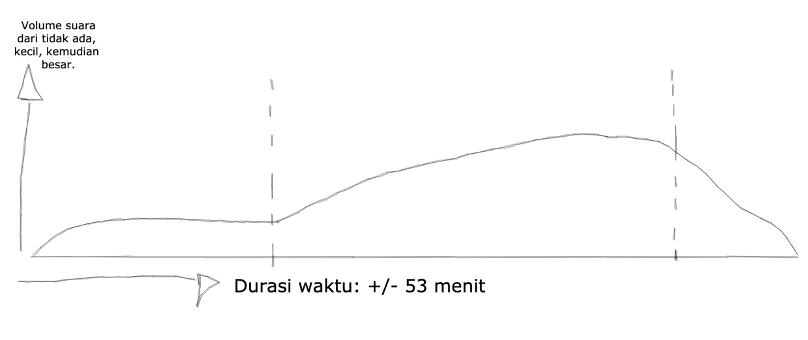
*Vertical arrow text in English: The volume of the sound goes from nothing, to small, then to large.
*Horizontal arrow text in English: Time duration +/- 53 minutes
Furniture Music
After closely watching Ambarchi’s performance videos on the YouTube channel “Exporatorium” and his album “Grapes from the Estate,” I realized that his music could also be read as music simply for listening. I came to this conclusion through the lens of a term called furniture music, coined in 1917 by French composer Erik Satie.
Furniture music (French: “musique d’ameublement”) is a term for a musical composition created specifically to serve as “background music” in a specific moment or physical space, where the audience does not need to focus on the performance of the musical composition. While it may sound a bit strange, furniture music can also be seen as music played to have the same status and function as furniture in a home.
Friends, you can read the following article from “Abbey Road Studios” which discusses a brief history of background music, which also touches on furniture music: Article Link
This reading of furniture music may be quite contradictory to my previous explanation of the deep listening activities that can be involved in Ambarchi’s improvised musical performances in the “Exploratorium.
But I think it’s perhaps not contradictory that Ambarchi’s musical performance at the Exploratorium was a live performance, indicating that the audience was there to watch. Therefore, deep listening could have been done.
Meanwhile, the album “Grapes from the Estate” is an artifact of his musical work. To listen to it, simply open the link to the album and play it while doing other daily activities. Therefore, I think it’s still possible to approach it from a furniture music perspective.
A Conclusion
That is more or less my discussion regarding a brief reading of the musicality of Oren Ambarchi’s musical improvisation performance at the Exploratorium.
Perhaps if fellow readers have their own opinions about the fourth edition of “Bakoknya Refleksi” writing, please write them in the comments, and let’s discuss or exchange feedback.
See you in the next edition of “Anyway, Reflecting”.
Good health and blessings always,
Rangga Purnama Aji, 2024.
(Revised and translated into English in 2026)